


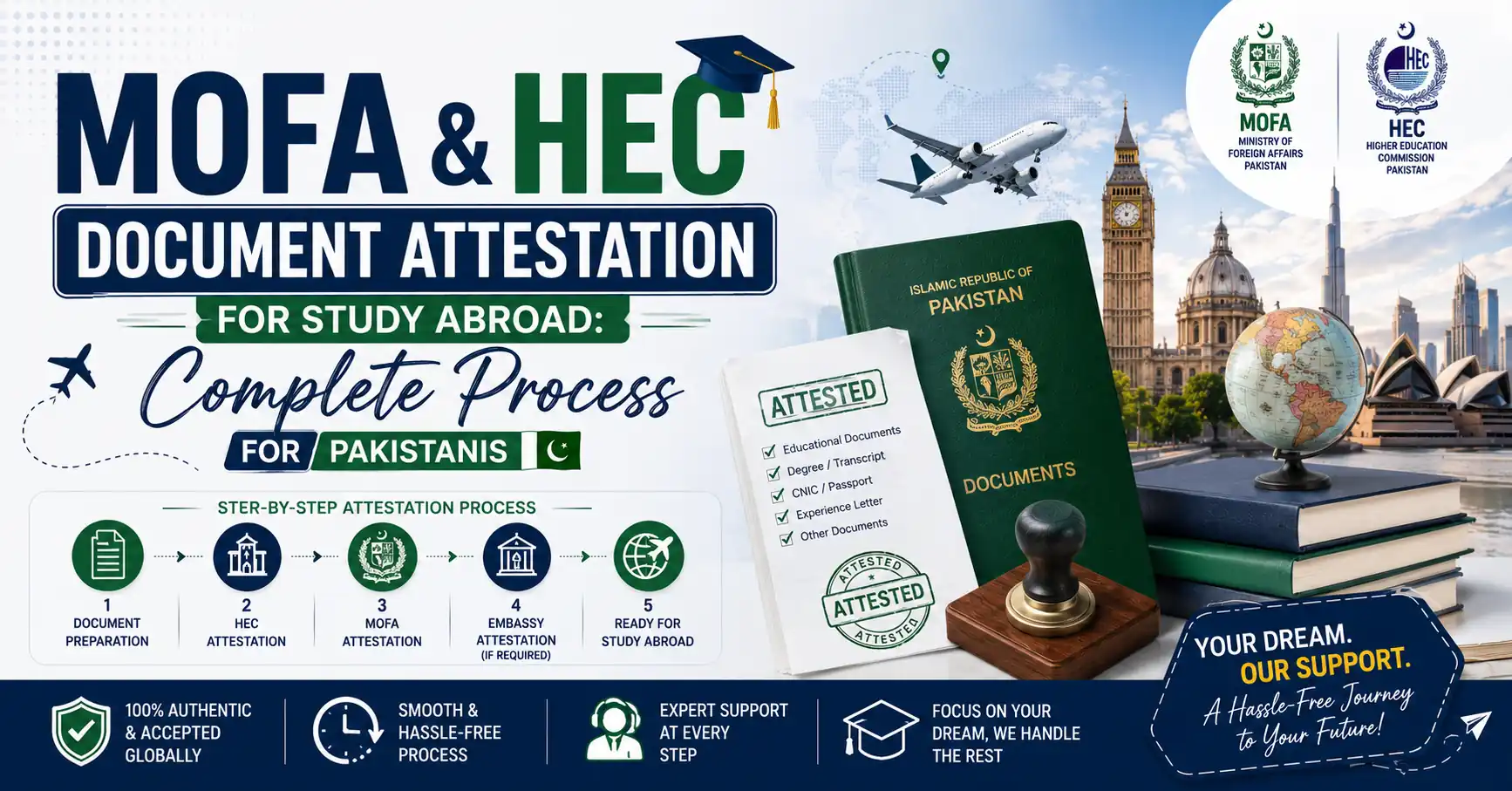
Planning to study abroad from Pakistan? You will need HEC document attestation and MOFA document attestation first. These two steps confirm that your academic documents are genuine. Foreign universities and embassies will not accept unattested documents. Whether you plan to study in UK, study in Germany, or study in Malaysia, attestation always comes first.
This guide explains the complete HEC document attestation and MOFA document attestation process for 2026. You will learn the required documents, fees, and timelines.
We also cover destination-specific requirements for the UK, Germany, France, Ireland, Italy, Sweden, Cyprus, Malaysia, and New Zealand. By the end, you will know exactly which office to approach and in what order. You will also understand realistic timelines so your visa file stays on track.
EduCrest Migration, a trusted name among the best study abroad consultants in Pakistan, helps students through every step of this journey.
What Is HEC Document Attestation?
HEC document attestation is the verification of your academic documents by the Higher Education Commission. HEC confirms that your degree is genuine. It also confirms that your university is properly recognized. Without HEC attestation, your degree carries little value outside Pakistan.
Foreign embassies simply reject unattested documents. As of 2026, HEC attestation runs through a fully online e-attestation system. You no longer need to visit HEC offices in person. The standard fee is around Rs. 3,000 per document.
Once approved, you receive a downloadable and verifiable e-certificate. If your degree comes from a foreign institution, HEC first issues an equivalence certificate. This confirms your qualification matches Pakistani academic standards.
HEC only attests documents for graduation, master’s, and higher qualifications. It does not handle Matric, Intermediate, or O and A Level certificates. Those documents go through IBCC verification instead. IBCC attestation usually happens before HEC or MOFA steps.
What Is MOFA Document Attestation?
MOFA document attestation is the final stamp from Pakistan’s Ministry of Foreign Affairs. It always comes after HEC verification. MOFA confirms that your document is ready for international use. Many countries now accept apostille attestation instead of standard MOFA attestation.
The apostille is a single certificate that replaces multiple attestation steps for Hague Convention member countries. Countries outside this convention still require standard MOFA attestation.
Either way, MOFA attestation remains mandatory for your study visa file. Gulf Cooperation Council countries like the UAE, Saudi Arabia, and Qatar now accept apostille too. This shift has simplified attestation for overseas job seekers as well as students.
Why Pakistani Students Need HEC and MOFA Attestation?
Every study abroad application starts with document verification. Universities in the UK, Germany, Ireland, and beyond ask for attested transcripts. Visa officers also check attestation before approving your student visa. Skipping this step delays your entire application.
Some students even face visa rejection because of missing attestation. Proper attestation proves your documents are authentic and legally valid. It builds trust with foreign institutions and immigration authorities. This is exactly why HEC document attestation and MOFA document attestation matter so much.
Attestation also protects you from fraud allegations later in your academic career. Many universities cross-check attested records directly with HEC and MOFA databases. This means shortcuts rarely work and often backfire. A properly attested file moves through visa processing much faster.
Documents That Usually Require Attestation
Not every paper in your study abroad file needs attestation. However, certain core documents always do.
- Bachelor’s, Master’s, or intermediate degree certificates
- Academic transcripts and detailed marksheets
- Matriculation and intermediate certificates from your education board
- Birth certificate, for some visa categories
- Experience letters, if you are applying with work experience
- Police Character Certificate, for certain long-term study programs
Board certificates often need IBCC attestation before HEC or MOFA can proceed. Always confirm exact requirements with your target university first.
HEC Document Attestation Process: Step by Step
The Higher Education Commission launched a fully digital attestation system in May 2026. Students no longer need to visit HEC offices in person. The entire HEC document attestation process now happens online through the HEC portal. Here is how it works, step by step.
Step 1: Create Your HEC Account
Visit the official HEC portal and register with your CNIC and basic details. Keep your mobile number and email active for verification codes.
Step 2: Upload Your Academic Documents
Upload scanned copies of your degree, transcript, and provisional certificate. HEC usually asks for your complete academic history, starting from Matric onwards.
Incomplete academic records can mark your application as deficient. This slows down your HEC document verification and delays your study abroad plans.
Step 3: Pay the HEC Attestation Fee
Pay the required fee online through debit card, credit card, or mobile wallet. Confirm your fee category before payment to avoid processing delays.
Step 4: Receive Your e-Attestation Certificate
HEC verifies your documents and issues a blockchain-secured e-attestation certificate. You can download this certificate and share it with universities or embassies directly.
Documents Required for HEC Attestation
- Original degree certificate with two photocopies
- Complete academic transcript with two photocopies
- Valid CNIC copy
- Recent passport-size photographs
- Equivalence certificate, for students with a foreign degree
HEC Attestation Fee and Timeline
The standard HEC fee is roughly Rs. 3,000 per document. Online processing usually takes a few working days. Urgent processing costs more but moves faster. Always confirm current fees on the official HEC website before applying.
MOFA Document Attestation Process: Step by Step
After HEC verification, your documents move to the Ministry of Foreign Affairs. This is the final step in Pakistan before embassy submission.
Step 1: Complete Pre-Verification
Make sure your document already carries HEC or IBCC attestation. MOFA does not accept documents without this pre-verification step.
Step 2: Book Your MOFA Appointment
Visit the official MOFA portal to book an online appointment. Choose your nearest MOFA office and select an available time slot.
Step 3: Submit Documents and Generate a Challan
Visit the MOFA office with your original and photocopied documents. A Challan Initiator will generate your fee challan on the spot.
An Assistant Consular officer will then review and verify your documents. This step confirms your document is ready for final attestation.
Step 4: Collect Your Attested or Apostilled Documents
Once verified, MOFA issues the attestation stamp or apostille certificate. Processing usually takes a few working days, depending on document type and workload.
Documents Required for MOFA Attestation
- HEC or IBCC-attested degree
- Original CNIC and passport copies
- Recent passport-size photographs
- Supporting documents like a birth certificate, where relevant
MOFA Attestation Fee and Timeline
MOFA charges roughly Rs. 3,000 per document for standard attestation. Apostille fees often range between Rs. 7,000 and Rs. 12,000. Normal processing takes about 7 to 10 working days. Urgent processing can finish within 24 to 48 hours.
HEC vs MOFA Attestation: Key Differences
Both steps work together, but they serve different purposes in your study abroad file.
| Aspect | HEC Attestation | MOFA Attestation |
| Authority | Higher Education Commission | Ministry of Foreign Affairs |
| Purpose | Verifies degree authenticity | Legalizes document for foreign use |
| Sequence | First step | Final step, after HEC |
| Mode | Fully online e-attestation | Online appointment plus courier or in-person |
| Approx. Fee | Rs. 3,000 per document | Rs. 3,000 to 12,000 per document |
Attestation Requirements by Study Destination
Attestation rules shift slightly depending on where you plan to study. Here is a quick breakdown for popular destinations.
Study in UK
UK universities require HEC-attested transcripts before confirming your enrollment. Apostille attestation works smoothly since the UK follows Hague Convention rules.
Most UK visa officers accept the digital e-certificate alongside the physical apostille stamp.
Study in Germany
German embassies request HEC-attested academic documents before visa interviews. Apostille certificates simplify Uni-Assist applications and German student visa processing.
A digitally verifiable certificate also speeds up the administrative processing phase of your file.
Study in France
French universities and Campus France ask for attested degree copies. MOFA apostille attestation speeds up your French visa file to study in France.
Submit your attested documents early since Campus France reviews can take several weeks.
Study in Ireland
Irish universities require HEC verification during admission processing. MOFA attestation then confirms your documents for the Irish visa office to study in Ireland.
Keep both digital and physical copies ready for your Irish visa appointment.
Study in Italy and Sweden
Both Italian and Swedish universities request HEC and MOFA attested documents. Apostille attestation is accepted across both countries.
Study in Cyprus
Cyprus universities need attested transcripts to issue admission letters. MOFA attestation also supports your Cyprus student visa application.
Study in Malaysia
Malaysian universities and immigration authorities require HEC-attested degrees. MOFA attestation remains a standard requirement for Malaysian study visas.
Some Malaysian institutions also request an additional verification letter from HEC directly.
Study in New Zealand
New Zealand’s immigration office checks attested academic records closely. HEC and MOFA attestation together strengthen your visa application.
Build in extra processing time, since New Zealand visa reviews tend to run longer.
How to Verify Your Attested Documents Online?
Verification protects you from fraudulent attestation stamps. HEC allows applicants to check their e-certificate status directly on the portal.
MOFA also offers an online apostille verification tool. Simply enter the verification number and date printed on your stamp.
Universities and embassies increasingly trust this digital verification layer. It removes doubt around physical stamps and speeds up admission decisions. Always keep your verification numbers safe until your visa is fully approved.
Timeline: When to Start Your Attestation Process
Start your HEC document attestation and MOFA document attestation early. Ideally, begin the process three to four months before your intended intake. This buffer covers scrutiny delays, courier time, and possible document objections. Waiting until your offer letter arrives is often too late.
Visa slots also fill quickly during peak intake seasons. An early start keeps your entire study abroad timeline stress-free.
Common Mistakes Students Make During Attestation
Avoid these mistakes to keep your study abroad application on track:
- Many students skip HEC verification and go straight to MOFA. This mistake causes rejection and wastes valuable time.
- Submitting an incomplete academic history to HEC. Choosing the wrong attestation fee category.
- Others submit laminated degrees, and attestation stamps cannot stick to plastic. Some students underestimate how long processing actually takes.
- Missing photocopies or incomplete forms also cause frustrating delays. Some applicants also enter mismatched CNIC or name details across documents.
- Even small spelling differences between your passport and degree cause objections. Working with an experienced education consultant in Islamabad helps you avoid these errors.
- Applying too close to your visa deadline is another frequent error. Rushed applications often skip verification checks and invite unnecessary risk.
MOFA Attestation vs Apostille: What Pakistani Students Should Know
Many students confuse MOFA attestation with an apostille. Both processes verify documents, but they apply to different countries. An apostille is a single-step certificate accepted by member countries of the Hague Apostille Convention. This includes the UK, Germany, Italy, France, Sweden, and several other European nations.
MOFA attestation is a traditional multi-step process. It applies to countries that are not part of the Hague Convention. Students planning to study in Europe, France, or Sweden usually need an apostille. Students applying to non-Hague countries still need full MOFA attestation.
How Does EduCrest Migration Help With Document Attestation?
EduCrest Migration is recognized among the best study abroad consultants in Pakistan. Our team guides you through your entire HEC document attestation and MOFA document attestation process. We assist in paperwork, portal submissions, and courier coordination. Whether you plan to study abroad in the UK, Malaysia, or across Europe, we guide you end-to-end.
As experienced education consultants in Islamabad, we also support university selection and visa filing. Our team tracks every document status until your file is fully cleared.
We also flag common objections before they cause rejection. This proactive approach saves students weeks of avoidable delay. From your first consultation to your final visa decision, we stay by your side. Our goal is a smooth, well-documented application, not just a submitted one.
Contact EduCrest Migration today to start your study abroad journey stress-free.
Frequently Asked Questions
The new digital system usually processes applications faster than the old manual method. Processing time still depends on document completeness and current application volume.
Yes, overseas Pakistanis can authorize a representative or use an authorized courier service. A blood relative can also submit documents on your behalf.
Yes. Apostille is a single-step certificate accepted across Hague Convention member countries.
No. MOFA attestation always requires prior HEC or IBCC verification of your documents.
Total cost usually ranges between Rs. 6,000 and Rs. 15,000 per document set.
No. The 2026 online system verifies scanned copies, so original submission is no longer required.
Yes, in most cases. HEC attestation must happen first, followed by MOFA attestation or apostille, depending on your destination country.
HEC will flag the objection, and you can correct and resubmit your documents.
HEC does not attest Matric, Intermediate, O Level, or A Level certificates. These require IBCC attestation instead.
No, apostille only works for Hague Apostille Convention member countries. Non-member countries still require full MOFA and embassy attestation.
Conclusion
HEC document attestation and MOFA document attestation are non-negotiable steps for every applicant. They validate your academic documents for international use. Completing them early prevents visa delays and unnecessary application rejection. Whether your destination is the UK, Germany, France, or Malaysia, start early.
EduCrest Migration, a leading study abroad consultant, simplifies this entire journey for you. Reach out today and let our experts help you with your document attestation process.
From HEC document attestation to MOFA document attestation, our team stays with you at every stage. Book your free consultation and take the first confident step toward studying abroad.
Post a Comment